Do Elbow Sleeves Actually Do Anything for Pressing?
Quick Answer: Elbow sleeves do three things: keep the joint warm, provide light compression that improves position sense, and give a small amount of elastic support out of the bottom of a press. They do not fix tendon problems and they do not add meaningful strength. If your elbows ache in a cold gym, they will help a lot. If you have a diagnosed tendinopathy, they are a comfort measure while you address the actual cause.
This is general information, not medical advice.
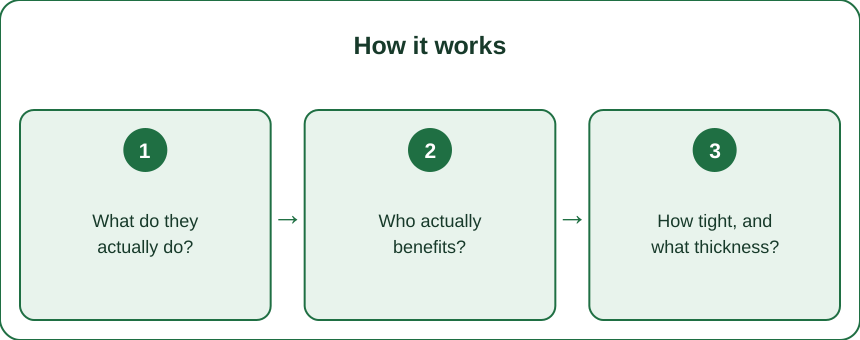
What do they actually do?
Warmth is the primary mechanism and the most underrated. The elbow has relatively little soft tissue covering it, so it cools fast in a cold gym. Warmer tissue is more compliant and simply feels better under load.
Compression improves proprioception. Light compression increases the sensory feedback from the joint, which for many people translates into a more consistent bar path and a steadier position at the bottom of a press.
There is a small elastic contribution. A stiff neoprene sleeve stores and returns a small amount of energy at the bottom of a bench press or overhead press. It is real and it is minor — nothing like the effect knee wraps have on a squat.
They restrict end-range extension slightly, which some people with hyperextending elbows find genuinely useful.
And they act as a reminder. Putting a sleeve on is a cue to warm up properly, which is probably doing as much work as the sleeve for a lot of people.
What they do not do is fix anything. A sleeve masks discomfort during a session and changes nothing about why the discomfort exists.
Who actually benefits?
People training in cold spaces. Home gyms in a garage, unheated warehouse gyms and anyone lifting early in the morning through autumn and winter get the largest and most obvious benefit.
Higher-volume pressers. Anyone doing a lot of bench, overhead and dip volume tends to notice accumulated elbow discomfort, and sleeves reduce it during the session.
People with hyperextending elbows, who often find the slight limitation at end range makes lockouts feel more stable.
Anyone returning from an elbow issue, as a confidence measure while volume rebuilds — with the caveat that this is a supplement to rehabilitation and not a replacement for it.
Who does not benefit: people with no elbow discomfort training in a warm gym. There is no strength gain waiting for you, and wearing them constantly is not free.
And they are not a fix for technique. Flared elbows on the bench, a bar path that stresses the joint, or a grip width that does not suit your structure are all mechanical problems that a sleeve simply lets you keep doing.
How tight, and what thickness?
Tight enough to stay in place, loose enough to leave on between sets comfortably. If you have to remove it after every set, it is too tight for training use.
5mm neoprene is the general-purpose choice — warmth, some compression, minimal restriction, and comfortable for a whole session.
7mm is stiffer and more supportive, better for heavy low-rep pressing and less comfortable for volume work or anything requiring full elbow flexion.
Fabric and knit sleeves are a different product entirely, giving warmth and light compression with no elastic support. For most people with mild aching, these are more comfortable and entirely sufficient.
Measure rather than guessing. Sizing is by arm circumference at a specified point, brands differ considerably, and a sleeve that is a size out does nothing useful.
Do not sleep in them or wear them all day. Sustained compression is not the goal and it is not doing anything helpful outside of training.
Myth vs Fact: Elbow Sleeves
Myth: They will add meaningful weight to your bench press. Fact: The elastic contribution is very small. Any noticeable improvement is more likely coming from warmth, comfort and confidence than from mechanical assistance.
Myth: They treat tennis or golfer’s elbow. Fact: They can make training more comfortable while you address the actual problem. Tendinopathy responds to progressive loading, load management and time, not to compression.
Myth: Wearing them makes your elbows weak. Fact: There is no good evidence that sleeves cause dependence or weakness, unlike the more plausible concern with heavy wraps. That said, if you cannot train without them, that is worth investigating rather than accommodating.
Myth: Tighter is better. Fact: Excessively tight sleeves restrict circulation and range of motion, and they are worse rather than better for the intended purposes.
Myth: They are only for heavy lifting. Fact: The warmth benefit applies most in high-volume and warm-up work, which is where a lot of elbow irritation actually accumulates.
Myth: Elbow sleeves and knee sleeves work the same way. Fact: The knee gets a genuinely useful elastic rebound out of the bottom of a squat because of the joint angles and loads involved. The elbow does not, to anything like the same degree, which is why expectations transferred from knee sleeves are usually disappointed.
FAQ: Elbow Sleeve Questions, Answered
Are they allowed in competition?
Rules vary by federation and by lift. Many powerlifting federations permit elbow sleeves in some divisions with specific length and thickness limits, and some prohibit them on the bench press. Check the current rulebook for your federation rather than assuming.
Should I buy sleeves or wrist wraps for elbow pain?
Neither, first. Elbow pain during pressing is frequently a wrist position or grip width problem, and fixing that resolves it. If the position is right and it still aches, sleeves are reasonable.
How long do they last?
Several years with normal use. Neoprene loses stiffness gradually, and the usual reason people replace them is smell rather than failure. Wash them regularly and air dry away from heat.
Should I wear them for pulling movements too?
Some people do for high-volume rows and curls. There is less mechanism there, and if it feels better it is not doing any harm.
TL;DR:
- Warmth, light compression and a small elastic effect — that is the whole mechanism.
- Biggest benefit in cold gyms and for high-volume pressing; minimal in a warm gym with no discomfort.
- They do not treat tendinopathy and they do not fix technique or grip width problems.
- 5mm neoprene for general use, 7mm for heavy low-rep work, knit sleeves for warmth alone.
- Check your federation’s rules before competing in them.
A sleeve buys comfort. It does not buy adaptation.
Keep Reading
This article is for general informational and styling purposes only. Fit, sizing, and product availability may vary.