Why Chalk Stops Working in Humid Gyms
Quick Answer: Chalk works by absorbing moisture, and it has a finite capacity. In a humid gym it saturates from the air before your set even starts, and re-chalking over saturated chalk makes a slippery paste. Liquid chalk, drier hands before application, and less chalk per application all work better than more chalk.
You chalk up. You grip the bar. Two reps in, the bar is rolling in your hands like it is greased.
You chalk again, heavier this time, and it gets worse.
Everyone assumes their grip is failing. In an August gym, the chalk is failing first, and the reason is straightforward.

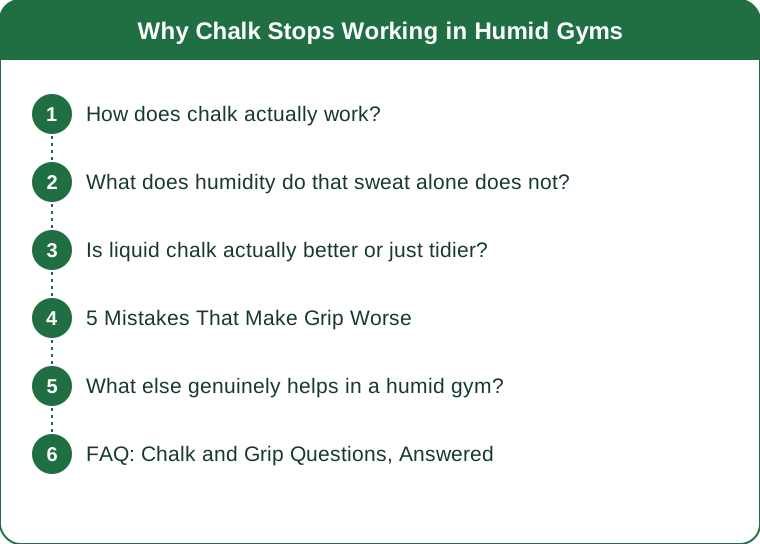
How does chalk actually work?
It absorbs moisture and increases friction. That is the whole mechanism, and both halves have limits.
Gym chalk is magnesium carbonate, a hygroscopic powder — it pulls water from its surroundings. Applied to hands, it absorbs sweat and skin moisture, leaving a drier surface with a higher coefficient of friction against a knurled bar.
The key constraint is capacity. A given amount of chalk can absorb a given amount of moisture and then it is done. Once saturated, it stops being a drying agent and starts being a wet powder, which is worse than no chalk at all because it fills the knurling and creates a lubricating layer.
That is why re-chalking mid-session so often makes things worse. You are adding dry powder on top of a saturated paste, and it mixes rather than replacing. The paste is the problem, and more chalk does not remove it.
What does humidity do that sweat alone does not?
It saturates the chalk before you have done anything.
Magnesium carbonate absorbs water from the air, not just from your skin. In a gym at 70 percent relative humidity, chalk in the bucket, chalk in your bag and chalk on your hands are all continuously pulling moisture out of the atmosphere.
In humid conditions your chalk arrives at the bar partly saturated, which means a large fraction of its capacity is gone before your first rep. What is left absorbs your sweat almost immediately.
This gets worse through a session. Your hands get sweatier, the air near the platform gets more humid from everyone else, and the chalk in the bucket has been absorbing all day.
There is a compounding effect on the bar too: chalk residue plus humidity fills the knurling, and a smooth bar in a humid room is genuinely hard to hold regardless of what is on your hands. This is why the same lift feels secure in a cold February gym and precarious in August with the doors open.
Is liquid chalk actually better or just tidier?
Genuinely better in humid conditions, for a specific mechanical reason.
Liquid chalk is magnesium carbonate suspended in alcohol. The alcohol evaporates rapidly, taking surface moisture with it and leaving a thin, even, bonded layer of chalk directly on the skin.
Two advantages matter here. It dries your hands as it applies, rather than relying entirely on absorption afterwards. And the layer adheres to the skin rather than sitting loose on it, so it does not turn to paste as readily and does not migrate into the knurling as fast.
The trade-offs are real: it takes 20 to 30 seconds to dry properly, and applying it to already-wet hands works poorly. It is also drying on the skin over time — regular users generally need moisturiser on non-training days or the calluses crack.
Best practice in a humid gym: liquid chalk as the base at the start of the session, dry chalk as a light top-up between sets. That combination handles the problem better than either alone.

5 Mistakes That Make Grip Worse
1. Applying chalk to wet hands. Chalk on genuinely wet skin makes paste immediately. Dry your hands on a towel first, every time. This one step fixes most humid-gym chalk complaints.
2. Using too much. A thin even coating outperforms a thick one. Excess chalk sits loose, transfers to the bar, and fills the knurling — which reduces grip for you and for everyone after you.
3. Never cleaning the bar. A wire brush on the knurling takes 30 seconds and restores a bar that has become genuinely slippery from accumulated chalk and skin oil. Most gyms have one somewhere and almost nobody uses it.
4. Ignoring your calluses. Thick, raised, uneven calluses reduce contact area and are the main cause of hands that slip despite good chalk. A callus shaver or a pumice stone once a week keeps them flat and functional.
5. Chalking over saturated chalk. If your hands feel pasty, wipe them clean and start again. Adding dry powder to wet powder produces wet powder.
What else genuinely helps in a humid gym?
Several things, in rough order of effect.
Dry your hands first. A small towel at the platform is the cheapest and most effective intervention available. Wipe, then chalk.
Brush the bar. If the knurling looks grey and smooth rather than sharp, it is holding chalk residue. Thirty seconds with a wire brush and it grips like a different bar.
Manage callus thickness. Flat and even is the target, not thick. Thick calluses tear as well as slip, and a torn hand costs a week.
Consider straps for the sets where grip is not the point. There is a persistent belief that straps are cheating, and it makes little sense for accessory work — if the goal of a rowing set is your back, letting grip end the set is training the wrong thing. Keep the top sets of your deadlift strapless if grip strength matters to you, and use straps for volume work.
Train grip directly, twice a week. Dead hangs, heavy carries and plate pinches. A stronger grip has more margin, which means it tolerates a bad chalk day rather than failing on one.
Time your session. Gyms are most humid in the evening, particularly in late summer with the doors open. If your grip-limited lifts keep failing, moving them to a morning session is a legitimate and free intervention.
FAQ: Chalk and Grip Questions, Answered
Does chalk quality actually vary?
Yes. Cheaper chalk often contains more filler such as magnesium oxide or drying agents, which reduces absorbency per gram. Pure magnesium carbonate performs noticeably better, though the difference is smaller than the difference between dry and wet hands.
Can I use liquid chalk if my gym bans loose chalk?
That is usually exactly what the policy intends, and it is worth checking rather than assuming. Most chalk bans exist because of airborne dust and residue, neither of which liquid chalk produces meaningfully.
Does antiperspirant on the hands work?
Some lifters use it the night before a heavy session and report a real effect, since it reduces sweat production directly rather than absorbing it afterwards. It is a legitimate approach for people whose hands sweat heavily, though it is not for daily use.
Should my hands be completely smooth?
No. You want calluses that are flat and even, not absent. Skin that is too soft tears more easily under a knurled bar, which is its own problem.
TL;DR:
- Chalk works by absorbing moisture and has finite capacity — humid air uses that capacity before your set starts.
- Re-chalking over saturated chalk creates paste, which is worse than no chalk at all.
- Liquid chalk dries as it applies and bonds to skin, which is why it handles humidity better.
- Dry hands first, use less chalk, brush the bar, and keep calluses flat.
Put a small towel in your gym bag this week. It is a genuinely unremarkable object and it will do more for your grip in a late-summer gym than anything you can buy in a tub.
Keep Reading
This article is for general informational and styling purposes only. Fit, sizing, and product availability may vary.