Do Lifting Shoes Actually Change Your Squat, or Is It Placebo?
Quick Answer: A raised, solid heel allows greater ankle dorsiflexion, which lets you achieve a more upright torso and deeper squat without compensating through excessive forward lean — the effect is real and measurable, though it matters more for people with limited ankle mobility than for those who already have it.
Lifting shoes look like a minor gear upgrade, but the raised heel genuinely changes squat mechanics for a specific reason, not just marketing.

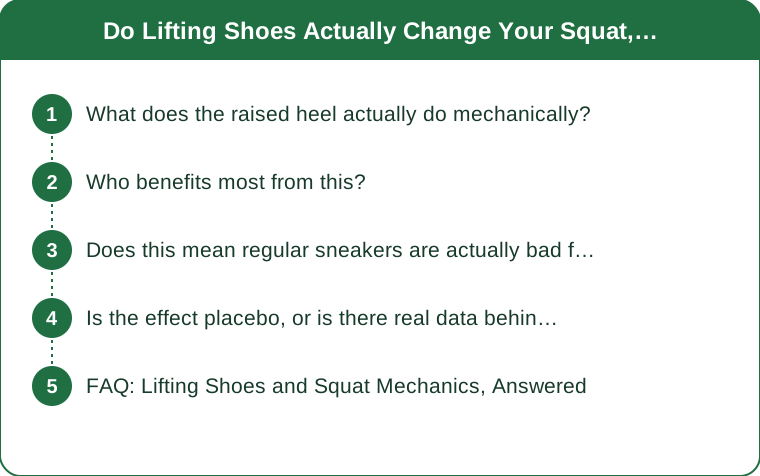
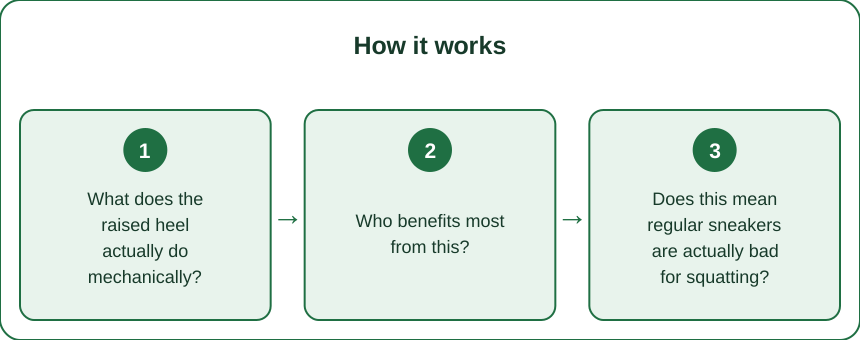
What does the raised heel actually do mechanically?
The elevated, solid heel reduces the ankle dorsiflexion demand needed to reach depth, letting your knees travel forward over your toes more easily while keeping your torso more upright — a real biomechanical shift, not a subjective feel.
Who benefits most from this?
Lifters with limited ankle mobility see the largest benefit, since the shoe compensates for a physical restriction rather than a technique flaw. Lifters who already have good ankle mobility notice a smaller, though still real, difference.

Does this mean regular sneakers are actually bad for squatting?
Not necessarily bad — but compressible, cushioned soles common in running shoes absorb force and allow slight instability under heavy load, which a flat, hard-soled or lifting-specific shoe avoids regardless of the heel height question.
Is the effect placebo, or is there real data behind it?
There’s genuine biomechanical data showing more upright torso angle and greater squat depth with a raised heel compared to flat shoes in lifters with restricted ankle mobility — this isn’t purely a psychological effect.
FAQ: Lifting Shoes and Squat Mechanics, Answered
Do I need lifting shoes to squat properly?
No — many lifters squat well barefoot or in flat shoes, especially with good ankle mobility; lifting shoes are a tool, not a requirement.
Will lifting shoes fix bad squat form on their own?
They can remove one specific mechanical limitation, but they won’t correct unrelated technique issues like bar path or bracing.
Is there a downside to wearing them for every lift?
Some lifters prefer a flatter shoe for deadlifts specifically, since the raised heel isn’t advantageous for that pull pattern.
TL;DR:
- The raised heel measurably reduces ankle dorsiflexion demand during a squat
- Lifters with limited ankle mobility benefit the most from the design
- Cushioned running shoes absorb force in a way flat or lifting shoes don’t
- The effect is real biomechanics, not just a placebo from new gear
Keep Reading
This article is for general informational and styling purposes only. Fit, sizing, and product availability may vary.