Do You Actually Need Different Lifting Shoes for Squats Versus Deadlifts?
Quick Answer: Yes, in a meaningful way — a raised heel improves squat depth and torso position by allowing more ankle range of motion, but that same raised heel increases the bar’s travel distance in a deadlift, which is the opposite of what a deadlift wants. Many lifters use a raised-heel shoe for squats and a flat, thin-soled shoe or bare feet for deadlifts specifically because the two lifts benefit from opposite sole geometry.
You bought one ‘good’ pair of lifting shoes assuming they’d work for everything. For squats and deadlifts specifically, that single-shoe assumption might be quietly costing you performance in one of the two lifts.

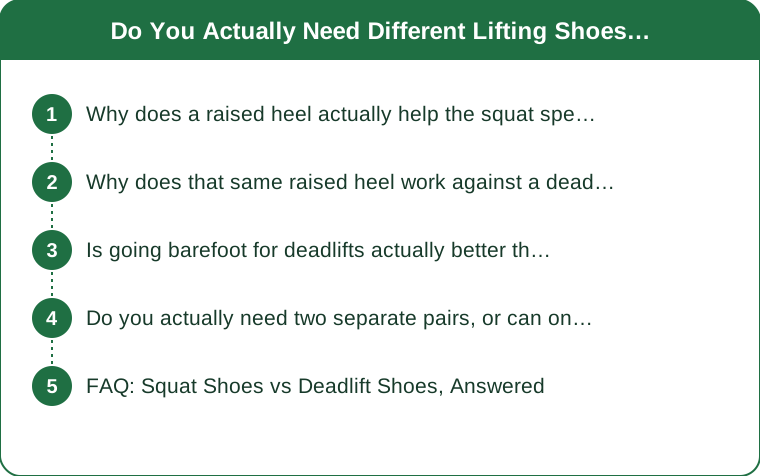
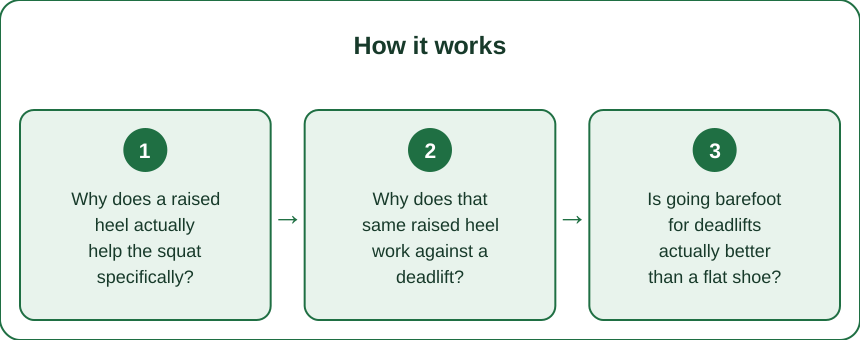
Why does a raised heel actually help the squat specifically?
A raised heel reduces the ankle mobility required to reach a deep squat position, letting lifters with tighter ankles keep an upright torso and hit full depth without compensating through excessive forward lean. This is why squat-specific shoes with a noticeable heel wedge are the standard recommendation for most lifters, regardless of ankle mobility level, since the wedge simply makes good positioning easier to access.
Lifters with naturally excellent ankle mobility sometimes squat fine flat, but a raised heel still tends to make consistent depth easier to repeat across fatigued sets.
Why does that same raised heel work against a deadlift?
A deadlift benefits from the shortest possible bar path, and a raised heel physically elevates your foot, which pushes your hips and the bar slightly further from the floor at the start of the lift, increasing total travel distance. Over a heavy set, that extra distance is a real, measurable disadvantage, which is why flat-soled or minimalist shoes are the standard recommendation specifically for deadlifting.
This is a small effect per rep, but it compounds over a full training block of maximal or near-maximal pulls.

Is going barefoot for deadlifts actually better than a flat shoe?
Barefoot or a very thin, hard-soled shoe minimizes both bar travel distance and unwanted compression under the foot, which is why many competitive deadlifters train and even compete without shoes where rules allow. A firm, thin-soled shoe gets most of this benefit while still providing basic foot protection, which is the more practical choice for most commercial gym settings.
A cushioned running shoe is the worst option for deadlifting specifically, since the compressible sole absorbs force that should be transferring directly into the lift.
Do you actually need two separate pairs, or can one shoe compromise well?
A flat, hard-soled shoe compromises reasonably well across both lifts, since it still gives a stable base for squats even without the heel-wedge depth assistance — the tradeoff mainly shows up for lifters with tighter ankles who specifically rely on the wedge for depth. Lifters chasing serious squat numbers with limited ankle mobility tend to see the clearest benefit from owning both shoe types.
For recreational lifters without ankle mobility limitations, one solid flat shoe is often good enough for both lifts without a real performance cost.
FAQ: Squat Shoes vs Deadlift Shoes, Answered
Can I just wear my squat shoes for deadlifts if that’s all I own?
You can, and it won’t ruin your deadlift, but you’re giving up a small amount of efficiency from the extra bar travel distance the raised heel adds.
How do I know if my ankle mobility needs a raised heel for squats?
If your heels lift off the ground or your torso collapses forward significantly at depth in flat shoes, a raised heel is likely to help meaningfully.
Are expensive weightlifting shoes necessary, or will any flat shoe work for deadlifts?
Any genuinely flat, non-compressible sole works for deadlifts — the price point matters far less than the sole geometry itself.
TL;DR:
- A raised heel helps squats by reducing the ankle mobility needed to hit depth with good positioning
- That same raised heel increases bar travel distance in a deadlift, working against efficiency
- Flat or minimalist shoes are the standard recommendation specifically for deadlifting
- One flat shoe compromises reasonably well for both lifts unless ankle mobility is a limiting factor
The two lifts genuinely want opposite things from a sole, so treating ‘lifting shoes’ as one single category is where the mismatch usually starts.
Keep Reading
This article is for general informational and styling purposes only. Fit, sizing, and product availability may vary.