Do You Need Lifting Gloves, or Are Calluses Better?
Quick Answer: Gloves reduce callus formation and improve comfort, and they cost you bar feel and effectively increase the bar’s diameter, which makes heavy grip work harder rather than easier. For most lifters, well-managed calluses plus chalk beats gloves. Gloves make genuine sense for people with skin conditions, for machine and cable work, and for anyone who simply prefers them enough that it keeps them training.
The callus is not a problem to eliminate. It is a problem to maintain.
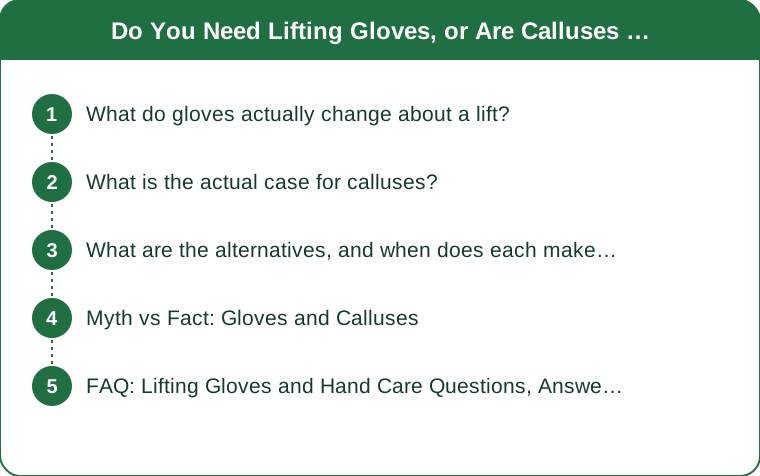
What do gloves actually change about a lift?
Three things, and the second one surprises people.
They add material between hand and bar. That reduces the pressure on the skin, which is the point, and it also reduces the friction and feedback you get from the knurling. Bar feel is real information - it is how you know the bar is centred, whether your grip is slipping, and how the load is distributed across your hand.
They effectively increase the bar diameter. A padded glove adds 3 to 5 millimetres of material all the way around, which is the same as gripping a noticeably thicker bar. A thicker bar is harder to grip, not easier - grip strength drops as diameter increases, which is precisely why fat-grip attachments exist as a training tool. So on heavy deadlifts, gloves can make grip the limiting factor sooner, which is the opposite of what people buy them for.
They can bunch. Fabric gathers in the palm under heavy load, which creates a pressure point and, in some cases, a rolling sensation as the bar shifts against the gathered material. This is more common with thicker gloves and heavier loads.
The honest summary is that gloves solve a comfort problem and create a performance one. For light to moderate loads, the trade is fine. For heavy pulling, it usually is not.
Where they clearly help: machines and cables with thin handles, dumbbells with aggressive knurling, anyone with a skin condition or recent hand injury, and cold outdoor training where bare hands on metal is genuinely unpleasant.
What is the actual case for calluses?
A callus is your hand adapting to the work, and adaptation is what training is for.
The skin thickens where pressure is repeated, producing a protective layer that spreads load and reduces the sensation of the bar cutting into the hand. A well-maintained callus is flat, smooth, and painless - it is not the raised, hard ridge that people picture.
The problem people actually have is not calluses. It is overgrown calluses, which become raised enough to catch on the bar, roll under load, and tear. A torn callus is genuinely painful, takes a week or more to heal, and stops you training - and it is entirely preventable with two minutes of maintenance a week.
Maintenance routine:
- File them weekly with a pumice stone or a callus file, after a shower when the skin is soft. The goal is flat and level with the surrounding skin, not removed.
- Do not cut them off with clippers or a blade. Removing the callus entirely leaves fresh skin exposed to the same load and it tears more easily than the callus did.
- Moisturize at night. Dry, thick callus is brittle and tears; supple callus does not. This is the step everyone skips and it matters most.
- Grip the bar lower in the palm, along the base of the fingers rather than deep in the palm. Bar placement is the main determinant of where and how badly calluses build.
That last point is the actual technique fix. Most severe callus problems come from gripping too deep, which lets the skin bunch and fold over the bar. Shifting the bar to sit at the top of the palm, where the fingers meet it, reduces the folding dramatically.

What are the alternatives, and when does each make sense?
There are four options between bare hands and full gloves, and they cover most situations better.
Chalk. The default answer for barbell work. It absorbs moisture and increases friction without adding any thickness, so you get better grip with full bar feel. This is what gloves are usually being bought to achieve, and chalk does it better. Liquid chalk is the version most gyms permit, since it does not produce dust.
Lifting straps. For heavy pulling where grip fails before the target muscle does. Straps let you train the back and hamstrings at loads your hands cannot hold. They are a tool for specific sets, not for the whole session - using them on everything means grip never develops. Use them on top sets of heavy pulls, and go strapless on everything else.
Grip pads. Small rubber or leather pads held in the palm. Thinner than gloves, no bunching, easy to drop into a bag. A reasonable middle ground for people who dislike full gloves but want some protection.
Hook grip or mixed grip. Technique rather than equipment. Hook grip - thumb under the fingers - is uncomfortable at first and hugely secure once learned. Mixed grip is easier and carries a small biceps tear risk on very heavy pulls, so alternate which hand is under.
A sensible default for most people: bare hands with chalk for barbell work, straps for the heaviest pulling sets only, and gloves for machines and cables if you want them. That combination gives you grip development where it matters and comfort where it does not cost anything.
Myth vs Fact: Gloves and Calluses
Myth: Gloves improve your grip. Fact: They usually reduce it, by adding effective bar diameter and reducing friction against the knurling. Chalk improves grip. Gloves improve comfort, which is a different thing.
Myth: Calluses mean you are doing something wrong. Fact: Calluses are normal skin adaptation to repeated pressure and every regular lifter has them. What is wrong is letting them overgrow until they tear.
Myth: You should shave calluses off completely. Fact: Removing the protective layer exposes soft skin to the same load, and it tears more easily than the callus would have. File them flat; do not eliminate them.
Myth: Straps are cheating. Fact: Straps let you train the target muscle at the load it needs, when the hands are the limiting factor. Using them on every set is a mistake because grip stops developing. Using them on heavy pulls is straightforward good practice.
Myth: Gloves prevent all hand pain. Fact: They reduce pressure and can introduce new problems - bunching, sweating, reduced feedback, and, for some people, more slipping rather than less. They also do nothing for the wrist pain that people sometimes attribute to grip.
Myth: You cannot use chalk in a commercial gym. Fact: Loose chalk is often banned; liquid chalk almost never is, because it leaves no dust. It is the single easiest upgrade available and most people have never tried it.
FAQ: Lifting Gloves and Hand Care Questions, Answered
How do I stop my calluses tearing?
File weekly, moisturize nightly, and grip the bar higher in the palm. Those three habits prevent nearly all tears. If one does tear, keep it clean, cover it, and avoid gripping until it closes.
Do gloves prevent calluses entirely?
They reduce them significantly, and they do not eliminate them. You will still develop some thickening at the pressure points, and you will have less bar feel while doing it.
Are gloves better for people with small hands?
Not particularly, and possibly worse - adding effective diameter to a bar is a bigger relative problem for a smaller hand. Chalk and a thinner grip pad are usually better options.
What about wrist support built into gloves?
The wrist support in most gloves is minimal. If you need wrist support, dedicated wrist wraps do the job properly and can be used with or without gloves.
Should beginners use gloves?
Most coaches would say start bare-handed with chalk, because bar feel is part of learning to lift and grip strength develops alongside everything else. If discomfort is genuinely stopping you from training, comfort wins - a glove you train in beats a bare hand you avoid.
TL;DR:
- Gloves add effective bar diameter and reduce bar feel, which makes heavy grip work harder, not easier.
- Calluses are normal adaptation. The problem is overgrown ones that catch and tear, and that is a maintenance issue.
- File weekly after a shower, moisturize nightly, and grip higher in the palm rather than deep.
- Chalk does what gloves are usually bought to do, without the thickness. Liquid chalk is allowed almost everywhere.
- Straps for the heaviest pulling sets only. Bare hands the rest of the time so grip develops.
If gloves are what keeps you lifting, wear them. Just know what they are costing you on heavy pulls.
Keep Reading
This article is for general informational and styling purposes only. Fit, sizing, and product availability may vary.