How to Tell If Your Lifting Belt Is the Wrong Width for Your Torso
Quick Answer: If your belt digs into your ribs at the bottom of a squat, forces you out of position on a deadlift, or you cannot brace fully because it will not let your abdomen expand, it is too wide for your torso. Short-torso lifters often do better with a tapered belt or a 3-inch back rather than the standard 4-inch. The test is simple: sit in your deepest squat position wearing it and see whether it pinches.
You bought the belt everyone recommends, and it hurts in the bottom of a squat in a way nobody warned you about.
That is not a break-in period. That is a fit problem, and it is remarkably common for anyone with a shorter torso.
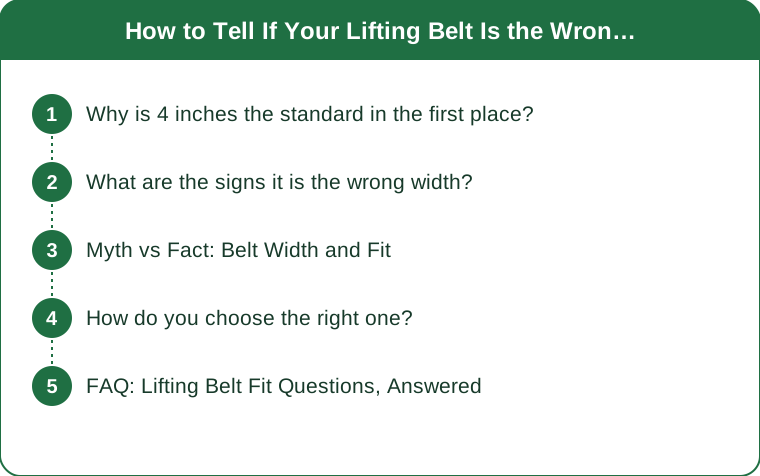
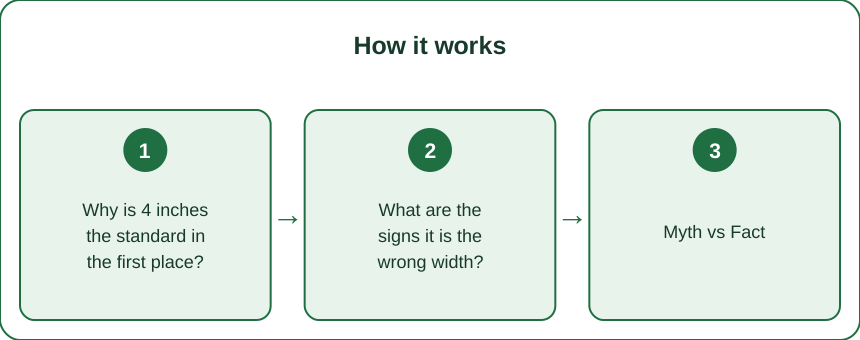
Why is 4 inches the standard in the first place?
Because of a rulebook, not because of anatomy.
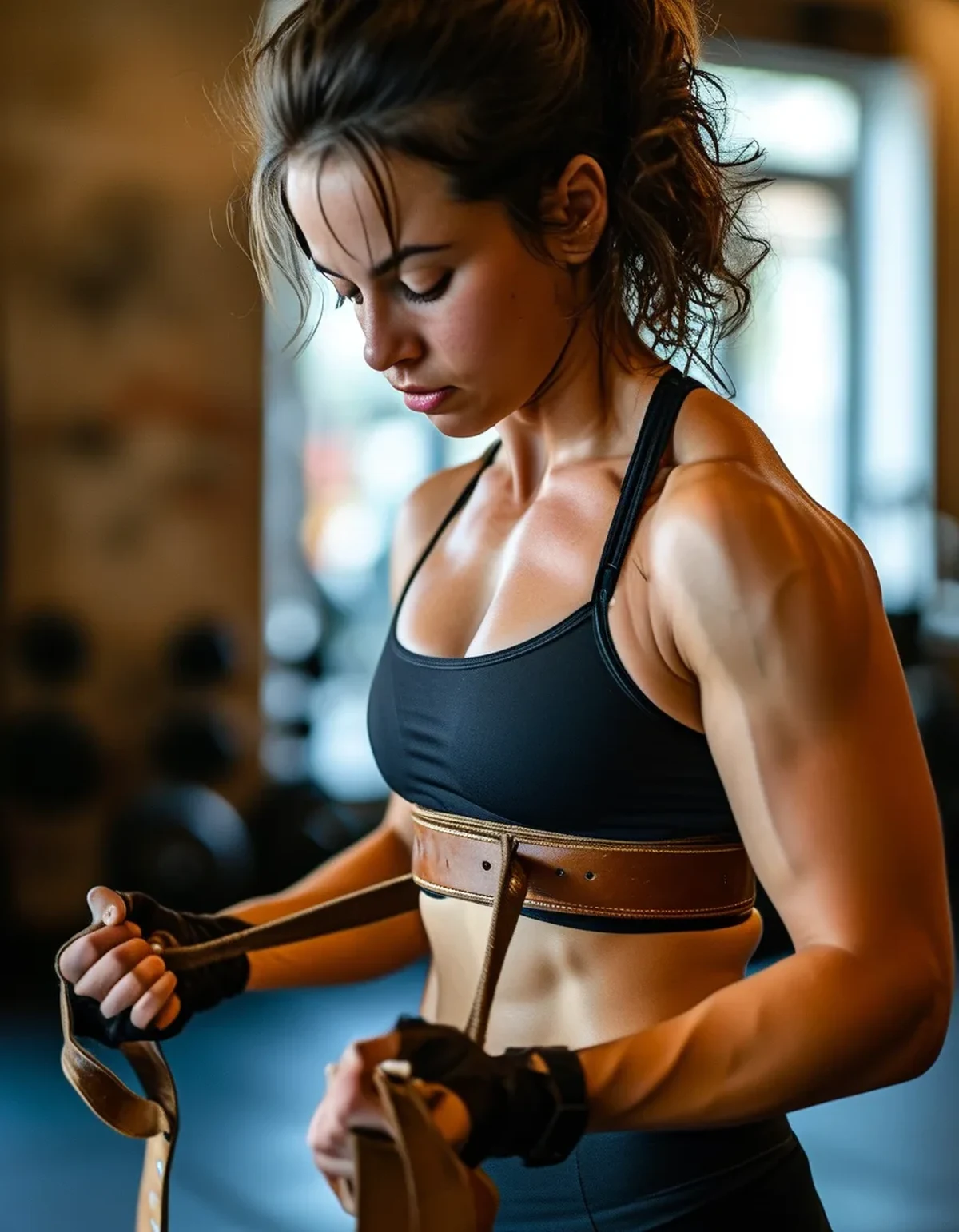
Powerlifting federations cap belt width at 4 inches (10 cm). That is the maximum allowed in competition, so manufacturers build to the maximum, and the maximum became the default recommendation.
The logic is that wider gives more surface area to brace against. That is true in principle — a wider belt distributes pressure across more of your abdominal wall and provides a larger surface for the abdomen to push out into.
But the maximum allowed is not the maximum useful for every body. The rule was written for a range of body types, and a 4-inch belt on a lifter with a short torso occupies a much greater proportion of the space between ribcage and pelvis than the same belt on a taller lifter.
Torso length varies far more than people assume. The distance from the bottom of the ribs to the top of the pelvis can differ by several inches between two people of the same overall height. That distance, not your height or your waist measurement, is what determines belt fit.
So the honest answer is that the standard belt is standard because of a competition rule, and matching it to your own torso is a separate question that nobody asks at the point of purchase.
What are the signs it is the wrong width?
Five, and they are specific enough to self-diagnose.
It pinches at the bottom of a squat. In deep flexion, the space between your ribcage and pelvis compresses. If the belt is taller than that compressed space, it has nowhere to go and it digs. This is the clearest sign, and it shows up at depth rather than at the top.
It forces your torso position on a deadlift. If setting up in your normal hinge means the belt jams into your ribs or your hips, you will unconsciously change your position to avoid it. A belt should support your position, not dictate it.
You cannot get a full brace. The point of the belt is something to push your abdomen against. If it is so tall that it restricts your ability to expand, you are getting less bracing, not more, which is exactly backwards.
Bruising or persistent marks at the ribs or hip bones. Redness after a heavy session is normal. Consistent bruising in the same spot means bone contact.
You only wear it for one lift. Plenty of people quietly stop using their belt for squats and keep it for deadlifts, or vice versa. That pattern usually means fit, not preference.
The test: put the belt on at training tightness and sit into your deepest squat position without weight. Any pinching there will be worse under load.
Myth vs Fact: Belt Width and Fit
Myth: A wider belt is always more supportive. Fact: Only if you can brace properly against it and it fits between your ribs and hips through a full range of motion. A belt you cannot brace into is less supportive than a narrower one you can.
Myth: Tapered belts are for beginners. Fact: Tapered belts — narrower at the front, wider at the back — are a legitimate solution for short-torso lifters and are used at every level. The front is where the clearance problem is; the back is where the width does not bother you.
Myth: You should size it by your waist measurement. Fact: Waist circumference determines the length, not the width. Two people with identical waists can need different belt heights. This is why buying online by waist size alone goes wrong so often.
Myth: It just needs breaking in. Fact: Leather softens and molds, which changes stiffness, not height. A belt that is physically too tall for the gap between your ribs and pelvis will still be too tall in two years.
Myth: Thickness and width are the same decision. Fact: They are separate. Thickness (10mm versus 13mm) is about stiffness and how much force it will resist. Width is about fit and clearance. Most people who think they need a thinner belt actually need a narrower one.
How do you choose the right one?
Measure first, then decide.
Measure your torso gap. Stand upright and find the bottom of your ribcage at the front and the top of your pelvis. Measure the distance. Then bend into your squat position and measure again — the second number is the one that matters, because that is your clearance under load.
If your compressed gap is under about 4 inches, a standard 4-inch belt will pinch. Look at a tapered belt, or a 3-inch belt if you are not competing.
If you compete, check your federation’s rules first. Some allow tapered belts, some do not, and buying a belt you cannot use on the platform is an expensive mistake.
Decide thickness separately. 10mm is easier to break in and adequate for most lifters. 13mm is stiffer and takes longer to soften, and it is genuinely uncomfortable if the width is also wrong. Start with 10mm unless you are lifting near the top of what a 10mm can resist.
Prong versus lever is a convenience choice, not a support one. Levers are faster to put on and off at one setting; prongs adjust more easily across body weight changes.
Try before buying if you possibly can. Ten seconds in a squat position tells you more than any review.
This is general information, not medical advice. Persistent rib, hip, or back pain during lifting should be assessed by a healthcare professional rather than solved with equipment.
FAQ: Lifting Belt Fit Questions, Answered
Should I just not use a belt if mine does not fit?
Lifting without a belt is completely reasonable and most people should be able to brace well without one first. But if you want one, the answer to a badly fitting belt is a better-fitting belt, not going without — a belt that fits genuinely helps on heavy sets.
How tight should it be?
Tight enough that you have to push out against it, loose enough that you can take a full breath into your abdomen. If you cannot breathe into it, it is too tight and you will get less bracing, not more. Most people over-tighten at first.
Does the same belt work for squats and deadlifts?
For most people, yes, though many lifters wear it slightly looser or positioned marginally differently for deadlifts because of the hinged torso position. If yours only works for one of the two, that is a fit signal worth taking seriously.
TL;DR:
- The 4-inch standard comes from a competition rule, not from anatomy — torso length varies more than height does
- Signs of a bad fit: pinching at squat depth, a forced deadlift setup, inability to brace fully, and consistent bruising
- Measure the gap between ribs and pelvis in your deepest squat position; under about 4 inches means look at tapered or 3-inch
- Width, thickness, and closure are three separate decisions — most people who want thinner actually want narrower
A belt is one of the few pieces of gym equipment where the popular recommendation is genuinely wrong for a sizeable share of people. Ten seconds in a squat before you buy saves the whole problem.
Keep Reading
This article is for general informational and styling purposes only. Fit, sizing, and product availability may vary.