Should You Get Lifting Straps Before a Belt? A Priority Guide
Quick Answer: For most beginner and intermediate lifters, straps are the more useful first purchase — they solve a common, earlier bottleneck (grip strength failing before back and legs) while belts are more relevant once you’re lifting near-maximal loads that challenge core bracing specifically.
Both pieces of gear solve real problems, but they solve different ones, and most people don’t need both starting on day one. Here’s how to think about which comes first.

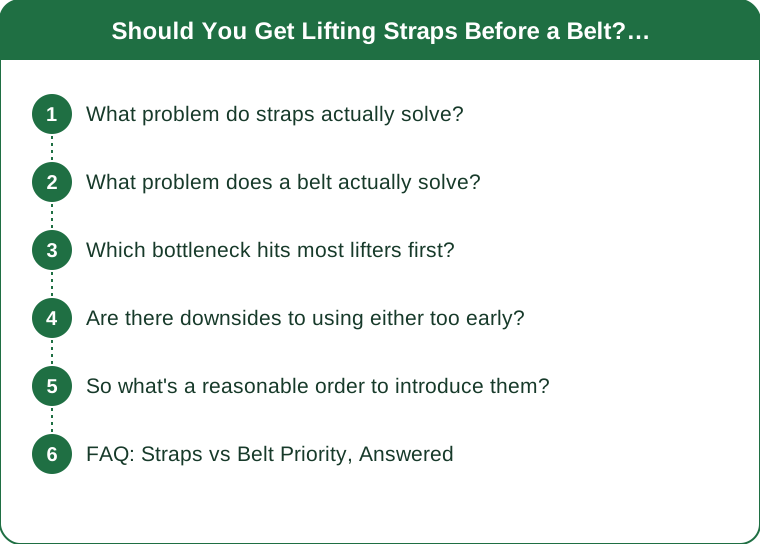
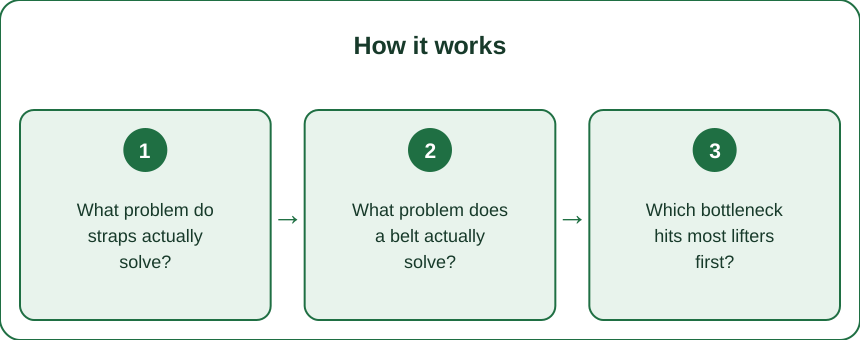
What problem do straps actually solve?
Straps address grip failure — for many lifters, especially in deadlifts and heavy rows, forearm grip fatigues before the target muscles (back, hamstrings, glutes) reach their actual limit. That means grip is capping how much training stimulus the bigger muscles get.
What problem does a belt actually solve?
A belt gives your core something to brace against, increasing intra-abdominal pressure during heavy lifts, which can improve spinal stability under near-maximal loads. It’s most relevant once loads are heavy enough that core bracing — not grip — becomes the limiting factor.
Which bottleneck hits most lifters first?
For the majority of people in their first 1-2 years of serious lifting, grip tends to become a limiter before bracing does — loads simply aren’t heavy enough yet for a belt to add meaningful benefit, while grip failure on deadlifts and rows shows up much earlier.

Are there downsides to using either too early?
Yes — relying on straps before grip has had a chance to develop can slow natural grip strength gains, and using a belt on loads that aren’t genuinely challenging can become a crutch rather than a tool, sometimes masking a core bracing weakness instead of supporting it.
So what’s a reasonable order to introduce them?
A common approach: build grip and core bracing without either tool through your first several months, introduce straps once grip is genuinely capping your pulling exercises, and introduce a belt later once you’re lifting loads that are genuinely near-maximal for compound lifts.
FAQ: Straps vs Belt Priority, Answered
Will using straps make my grip weaker over time?
Using them exclusively can slow grip development, but many lifters use straps only on their heaviest sets while still training grip directly on lighter sets and dedicated grip work.
At what weight should I actually start considering a belt?
There’s no universal number, but many lifters start experimenting with a belt once compound lift loads approach roughly 80%+ of their one-rep max on a regular basis.
Can I just buy both at the same time?
There’s no harm in owning both, but using both immediately can delay building baseline grip strength and core bracing — introducing them as actual bottlenecks appear tends to build a more complete strength base.
TL;DR:
- Straps solve grip failure; belts solve core bracing under near-maximal loads
- Grip tends to become a limiter earlier in most lifters’ training than bracing does
- Using either tool too early can mask a weakness instead of building around it
- Build baseline grip and bracing first, then introduce each tool as its specific bottleneck appears
Most beginners get more immediate value from straps; belts earn their place once loads get genuinely heavy.
Keep Reading
This article is for general informational and styling purposes only. Fit, sizing, and product availability may vary.