Resistance Bands vs. Chains for Accommodating Resistance: What Actually Differs
Quick Answer: Both bands and chains increase resistance as a lift moves toward the top of the range of motion, but bands ramp up tension smoothly and continuously through the stretch, while chains add resistance in discrete increments as more links lift off the floor — bands generally suit smaller home setups and more dramatic tension curves, while chains offer a steadier, more linear resistance increase favored in many strength and powerlifting programs.
Both tools solve the same basic problem, which is that most lifts get mechanically easier near the top, but they solve it in genuinely different ways.

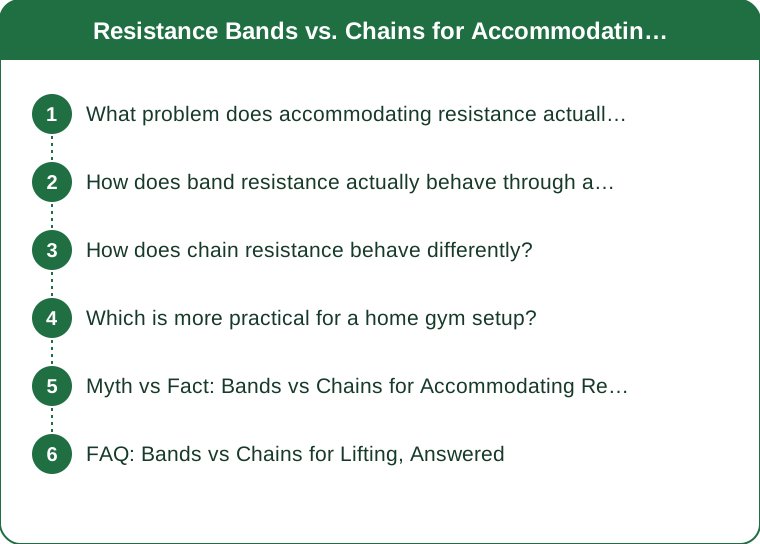
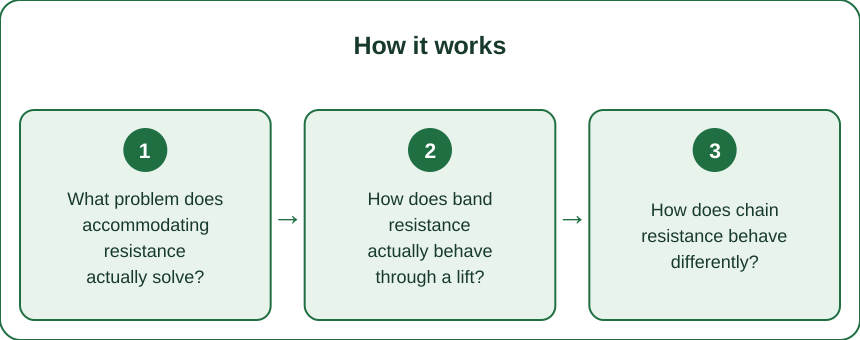
What problem does accommodating resistance actually solve?
Most barbell lifts have a strength curve where the lift feels hardest at a specific point (often near the bottom) and progressively easier as the joint angles change through the rest of the range. Accommodating resistance tools add extra load specifically during the easier portion of the lift, forcing continued effort through the entire range instead of coasting through the top.
How does band resistance actually behave through a lift?
Bands stretch progressively, meaning resistance increases in a smooth, continuous curve as the band lengthens — the tension at the very top of a lift can be dramatically higher than at the bottom, depending on band tension and how much stretch is involved. This creates a noticeably more aggressive tension increase than most lifters expect the first time they try it.
How does chain resistance behave differently?
Chains add resistance in discrete steps as more links lift off the floor with the bar — the increase is more linear and gradual compared to a band’s exponential-feeling stretch curve, which many lifters describe as feeling more “natural” and closer to standard barbell loading, just adjusted through the range.

Which is more practical for a home gym setup?
Bands are generally more practical for home use — they’re inexpensive, compact, and can attach to a squat rack, door anchor, or even just be stood on, without needing extra floor space. Chains require more setup complexity (specific hooks or collars, adequate floor clearance) and are heavier and bulkier to store, which tends to favor commercial gym settings over home setups.
Myth vs Fact: Bands vs Chains for Accommodating Resistance
Myth: Bands and chains are interchangeable and it doesn’t really matter which is used. Fact: The resistance curve shape is genuinely different between the two — bands ramp more aggressively and chains more linearly, which changes how a lift actually feels through the range, not just the total added load.
Myth: Accommodating resistance tools are only for advanced powerlifters. Fact: Both tools are used across a wide range of experience levels for addressing specific sticking points, though very light band tension is a reasonable starting point for less experienced lifters.
FAQ: Bands vs Chains for Lifting, Answered
Which is better for someone specifically working on a sticking point in their squat or bench?
Both can help, but chains’ more linear increase is often preferred for precisely targeting a known sticking point, while bands’ more dramatic curve suits general strength-through-range training.
Do bands or chains wear out faster?
Bands degrade over time with UV exposure, stretching, and general wear, eventually needing replacement — chains are far more durable and, with basic care, can last for years without meaningful degradation.
Is it common to use both bands and chains in the same program?
Yes, though usually not in the same single lift — many programs rotate between the two across different training blocks or exercises to vary the type of resistance curve the body adapts to over time.
TL;DR:
- Both tools add resistance as a lift moves toward the easier top portion of the range
- Bands ramp tension in a smooth, continuous, more aggressive curve
- Chains add resistance in discrete, more linear steps as links lift off the floor
- Bands suit home gym practicality better; chains suit dedicated sticking-point work
Neither tool is objectively better — the resistance curve each one creates is genuinely different, and the right pick depends on which specific problem in the lift is actually being solved.
Keep Reading
This article is for general informational and styling purposes only. Fit, sizing, and product availability may vary.