The Lifting Belt Mistake That Cancels Out Its Whole Benefit
Quick Answer: Wearing a belt but not actively bracing the core against it cancels out most of its benefit — the belt only helps when you push your abdomen outward into it during a lift. Practicing that brace without the belt first, then adding it, fixes the most common misuse.
A lot of lifters put a belt on and expect it to do the bracing for them — but the belt only works if you’re actively pushing against it.

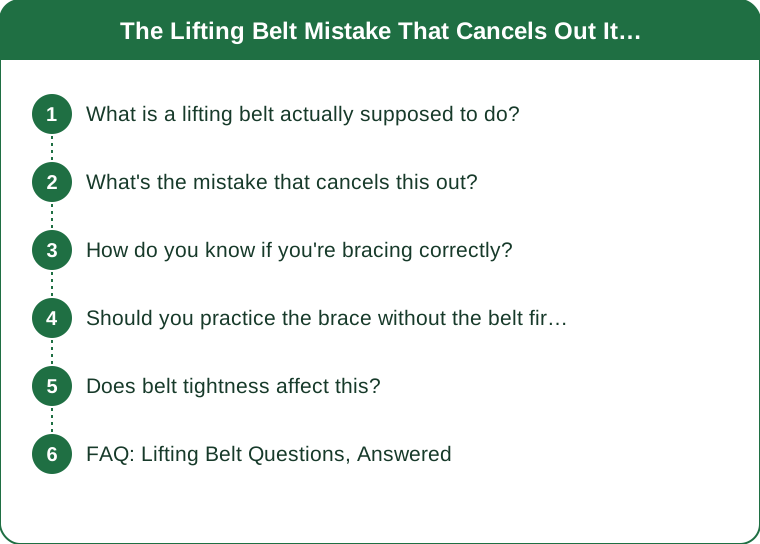
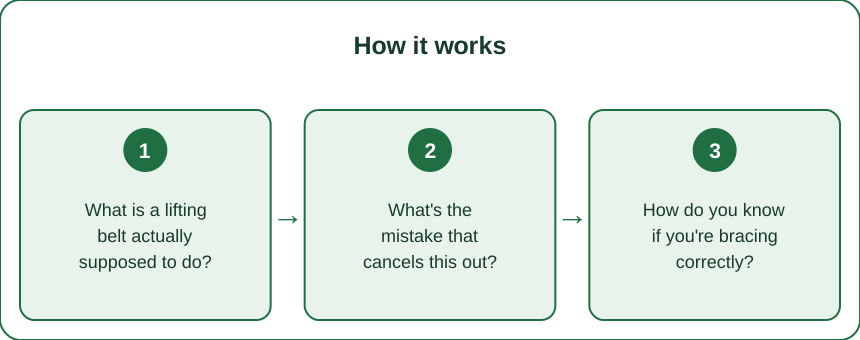
What is a lifting belt actually supposed to do?
A belt gives the core something rigid to brace against, increasing intra-abdominal pressure when you actively push your midsection outward into it, which supports the spine during heavy compound lifts.
What’s the mistake that cancels this out?
Simply wearing the belt snug without actively bracing against it provides little of the intended benefit — the belt is a bracing aid, not a passive support that works on its own.
How do you know if you’re bracing correctly?
A correct brace involves taking a deep breath into the belly, then pushing outward against the belt from all sides — front, sides, and back — rather than just tensing the front abdominal wall.

Should you practice the brace without the belt first?
Yes — many coaches recommend learning to brace unassisted first, since it teaches the actual muscular pattern; the belt then becomes a tool that enhances an already-correct brace rather than a substitute for it.
Does belt tightness affect this?
A belt that’s too loose gives nothing to brace against, while one that’s too tight can restrict the breath needed to brace properly — a snug-but-breathable fit works best.
FAQ: Lifting Belt Questions, Answered
Do beginners need a lifting belt?
Most coaches suggest building baseline bracing strength without a belt first, introducing one later for near-maximal heavy compound lifts specifically.
Should a belt be worn for every set, including warm-ups?
Most lifters only need a belt for their heaviest working sets, not lighter warm-up or accessory work.
Can a belt become a crutch that weakens core strength over time?
Overuse on lighter sets where it isn’t needed can reduce reliance on unassisted core bracing, so reserving it for genuinely heavy sets helps avoid that.
TL;DR:
- A belt only helps when you actively brace against it, not just wear it snug
- The correct brace pushes outward on all sides, not just the front abdominal wall
- Learning to brace without a belt first builds the pattern the belt then enhances
- Reserving belt use for genuinely heavy sets avoids over-reliance on it
A lifting belt amplifies a good brace — it doesn’t replace the need to learn one in the first place.
Keep Reading
This article is for general informational and styling purposes only. Fit, sizing, and product availability may vary.