When a Lifting Belt Actually Helps - and When It Just Gets in the Way
Quick Answer: A lifting belt works by giving your abdominal wall something to brace against - you breathe into your belly, push outward into the leather, and intra-abdominal pressure rises beyond what you manage unbelted, stiffening your trunk for heavy squats and deadlifts. That means the belt amplifies a bracing skill; it cannot replace one you have not built. It earns its place on compound barbell lifts above roughly 80 percent effort, and it gets in the way everywhere else - warm-ups, isolation work, most dumbbell training, and any set where you are using it as a substitute for learning to brace.
Someone at the gym said you need a belt. Someone online said belts are a crutch. Both are wrong in useful ways, and the truth fits in one session.

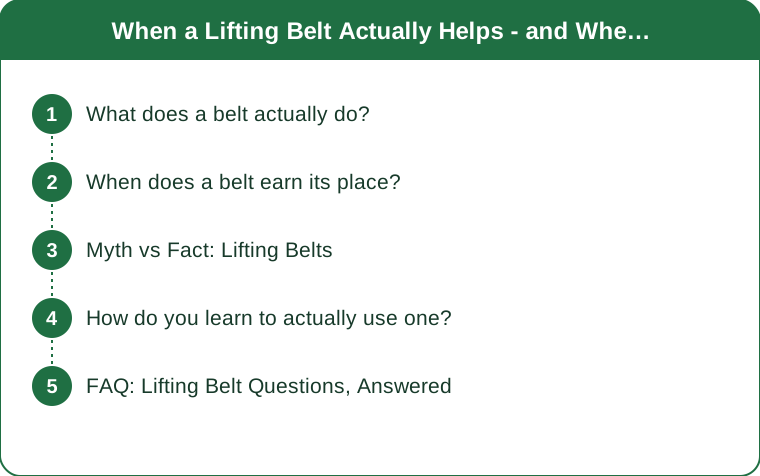
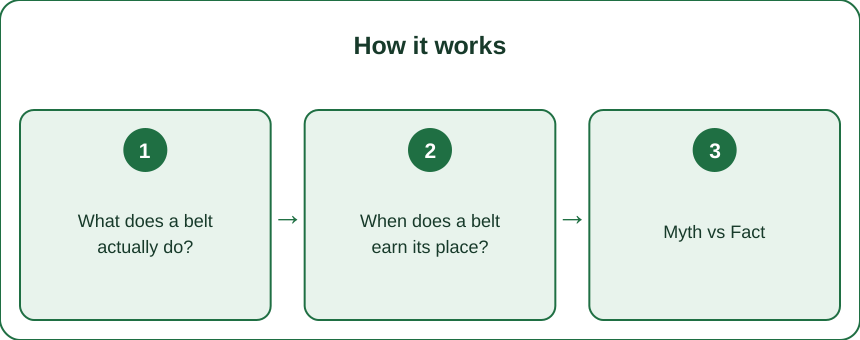
What does a belt actually do?
Not what the name suggests - it is not holding anything up.
Your trunk stiffens by pressure, not just muscle. Before a heavy pull, you breathe into your belly and brace - the abdominal canister pressurizes, and that internal pressure stabilizes the spine from the inside, like an inflated can resisting a crush.
The belt is a wall to push against. With leather circling the midsection, the outward push of your brace meets resistance, and the same effort produces meaningfully higher intra-abdominal pressure. Studies and meet platforms agree: braced-with-belt beats braced-without by a real margin.
It is an amplifier with no input of its own. Strap a belt on a lifter who has never learned to breathe and push into it, and almost nothing happens - a passive belt worn loose over an unbraced core is decoration. The order is non-negotiable: bracing first, belt second.
What it is not: back armor. A belt does not hold your spine in place, does not compensate for a rounding back, and does not make a bad position safe. Lifters who treat it as protection push form errors harder - the belt amplifies pressure, and it will amplify pressure into a bad position just as happily.
The measurable payoff is performance. Belted lifters typically move a few percent more weight or grind out an extra rep at the same weight on squats and deadlifts. Over months, those extra kilos of stimulus compound - which is the honest case for the belt: not safety theater, but a bigger training dose on the lifts that matter.
And it has a learning cost. Bracing into a belt is its own skill with a two-or-three-session adjustment period where lifts may briefly feel worse. Normal, temporary, worth it.
When does a belt earn its place?
A simple decision rule covers nearly every case.
Wear it: heavy compound barbell work. Squats, deadlifts, and their variations at roughly 80 percent of max and above - the top sets, the heavy triples and fives, max attempts. This is the zone where amplified pressure translates directly into kilos and rep quality.
Wear it: heavy overhead and row work, optionally. Many lifters belt heavy overhead presses and barbell rows at the top end. Reasonable, personal-preference territory.
Skip it: everything light and medium. Warm-ups, sets below 80 percent, and accessory work belong to your unbelted brace - this is precisely where that skill gets trained. Belting every set from the empty bar outsources your core’s education to leather.
Skip it: isolation and machine work. Curls, leg press, lat pulldowns - the belt is doing nothing but compressing your dinner.
Skip it: conditioning and high-rep circuits. Breathing patterns in continuous work fight the belt’s valsalva rhythm; you cannot pant into a brace.
The timeline question matters more than the equipment question. Add a belt when you can already squat and hinge with a confident unbelted brace and your top sets are heavy enough to deserve amplifying - for most lifters, several months to a year in. Add it earlier and it becomes a security blanket that stunts the very skill it needs; add it never and you leave easy kilos on the table at the top end.
A working weekly pattern: everything to 80 percent beltless, belt on for the top work, one heavier beltless block every few months to audit the gap. Belted and unbelted numbers should rise together, a few percent apart.

Myth vs Fact: Lifting Belts
Myth: Belts prevent back injury. Fact: Belts raise bracing pressure and let you handle more load - they do not fix positions or forgive rounding. Injury risk lives mostly in load management and technique; a belt changes neither, and false confidence can worsen both.
Myth: Beginners should belt up from day one. Fact: Beginners need months of unbelted bracing practice first - the belt amplifies that skill and cannot substitute for it. Early belting builds dependence on equipment instead of capacity in the core.
Myth: Real lifters never need a belt. Fact: Nearly every serious strength athlete belts their top work, and the performance margin is well documented. Permanent beltlessness is an aesthetic position, not an evidence one.
Myth: Wear it tight enough to hurt. Fact: Correct tightness leaves room to breathe into the belt - roughly a flat hand’s snugness. Strangulation-tight prevents the belly expansion that creates the pressure, making the belt actively counterproductive.
Myth: The belt goes in the same spot for everyone. Fact: Position is personal - higher toward the ribs suits some torsos for squats, lower across the navel suits others for pulls. Torso length decides; two sessions of experimenting finds your spot.
Myth: Any sturdy belt is the same. Fact: For barbell bracing you want uniform width - 10cm, or 7.5cm for shorter torsos - in stiff leather with a buckle or lever. The tapered padded cardio belts and velcro numbers compress nicely and brace barely at all. One good belt is a decade purchase; this is not the item to economize twice on.
How do you learn to actually use one?
The belt pays out in proportion to the bracing skill underneath it. Build in this order.
Week zero: own the unbelted brace. On the floor, hand on belly: breathe so the hand rises, ribs stay down, then push the belly outward gently and hold while breathing shallowly behind the pressure. Then standing, then under a light bar. This 360-degree outward push - front, sides, and back - is the entire foundation.
First belted sessions: light and experimental. Belt on at moderate weight, one notch looser than instinct suggests. Big belly breath, push out hard into the leather all the way around - the cue that works for most people is push into the belt everywhere at once, not suck in. You should feel the pressure meet the wall.
Find your position and tightness. Slide it higher or lower until nothing pinches at the bottom of a squat or the setup of a pull; adjust notches until you can inhale fully into it but not slide two fingers in easily. Log the notch and position once found - consistency is part of the skill.
Re-breathe between reps, behind the brace. Top of each rep: partial exhale, re-breathe into the belt, next rep. Never fully deflate mid-set.
Dress for the interface. A belt rides directly on your midsection through whatever you wear, and fabric matters more than expected: a smooth-waisted pair of high-waisted leggings sits flat under leather where thick seams and drawstring knots dig by set three. Most lifters end up with a slight wardrobe preference for exactly this reason - the belt should press into you, not into hardware.
And keep auditing. If your beltless lifts stagnate while belted ones climb, the gap is widening - schedule a beltless block. The belt is a top-end tool; the engine underneath stays yours to maintain.
FAQ: Lifting Belt Questions, Answered
Do I need a lifting belt as a beginner?
Not yet. Spend your first months building an unbelted brace - the belt amplifies that skill and does nothing without it. Add one when your squat and deadlift top sets are genuinely heavy and your unbelted bracing is confident, typically several months to a year in.
How tight should a lifting belt be?
Snug with room to breathe into it - about one notch looser than feels tough. You should be able to inhale into your belly and feel the belt resist; if you cannot expand at all, it is too tight to brace against and is costing you pressure.
Does a belt weaken your core?
Not if you use it only for top-end work - your core still brakes every warm-up and mid-weight set unbelted. Dependence comes from belting everything from the empty bar up, which is a usage error rather than a belt property.
Where should the belt sit?
Wherever your torso braces best without pinching - higher near the ribs works for many squatters, lower across the navel for many pullers, and short torsos often need narrower belts entirely. Two sessions of experimenting settles it; then keep it consistent.
How much more can you lift with a belt?
Commonly a few percent - an extra rep at a given weight or several added kilos on top sets - once the bracing-into-the-belt skill clicks. The first two or three sessions may feel awkward or even weaker; that adjustment is normal and short.
TL;DR:
- A belt is a wall for your brace: breathe in, push out into leather, and trunk pressure rises beyond unbelted levels.
- It amplifies a skill - build the unbelted brace first, then add the belt to top-end squat and deadlift work.
- Skip it for warm-ups, accessories, machines, and conditioning; belting everything stunts the core it depends on.
- Snug-not-strangling, positioned where your torso likes it, uniform-width stiff leather.
- Audit with occasional beltless blocks so both numbers keep climbing.
The belt is neither armor nor cheating - it is an amplifier for the strongest thing you build yourself. Earn the brace, then let the leather pay interest on it.
Keep Reading
This article is for general informational and styling purposes only. Fit, sizing, and product availability may vary.