Why a Lifting Belt Can Make You Weaker If You Use It Too Early
Quick Answer: A lifting belt works by giving your core something to brace against, increasing intra-abdominal pressure for better spinal support — but if you start relying on one before you’ve learned to properly brace your core without it, you can end up with a weaker, underdeveloped core than lifters who built bracing strength first.
A belt amplifies a brace you already know how to create. It doesn’t create that brace for you, and that distinction is where a lot of lifters go wrong.

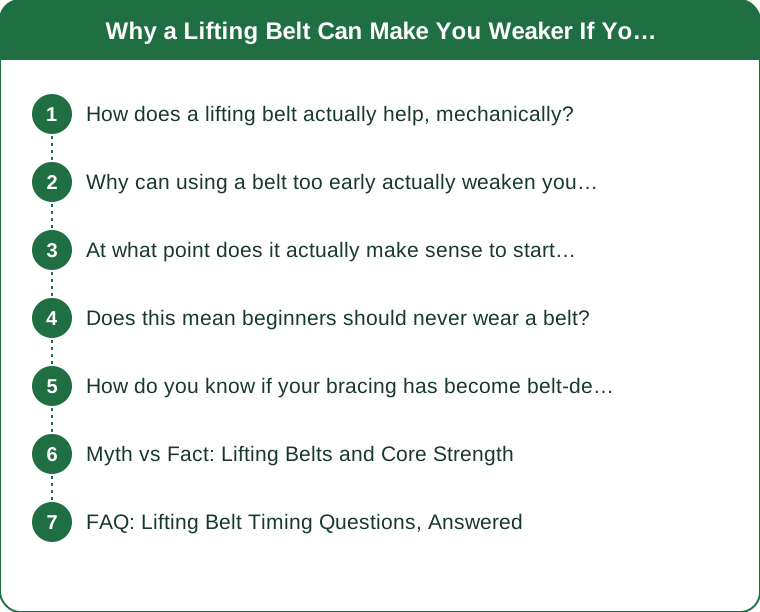
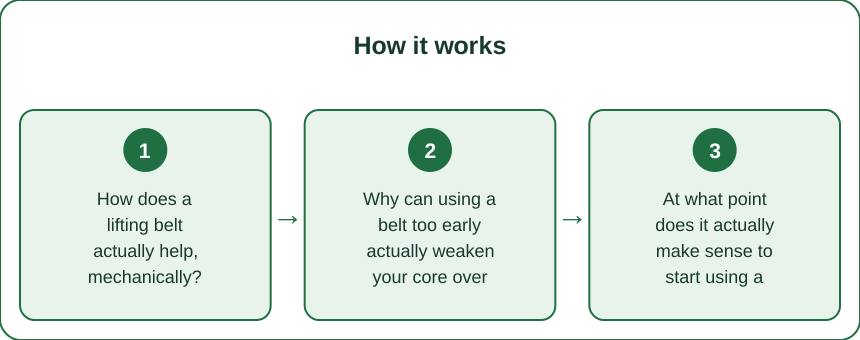
How does a lifting belt actually help, mechanically?
A belt gives your abdominal and core muscles something rigid to push against, which increases intra-abdominal pressure when you brace correctly, providing extra spinal stability under heavy load. This only works if you’re actively bracing against it — simply wearing a belt without engaging your core provides little to no benefit.
Why can using a belt too early actually weaken your core over time?
If a lifter starts using a belt before developing a strong bracing pattern, they can unconsciously rely on the belt’s rigidity instead of their own core engagement, meaning core strength develops more slowly than it would training beltless. Over months, this can create a gap where a lifter’s beltless bracing strength lags noticeably behind their belted lifting numbers.
At what point does it actually make sense to start using a belt?
Most coaches recommend introducing a belt once a lifter can consistently and correctly brace without one across a range of working weights, often once approaching weights around 80%+ of a true one-rep max on main lifts like squats and deadlifts. Below that threshold, the core strength benefit of training beltless generally outweighs the marginal performance gain a belt provides.

Does this mean beginners should never wear a belt?
Not necessarily for all lifting — a belt during very heavy, near-max attempts even for less experienced lifters can be reasonable for safety, but wearing one for every single set at moderate weights removes the core-training stimulus those lighter sets would otherwise provide. The distinction is using a belt strategically for genuinely heavy work, not as a default for every rep.
How do you know if your bracing has become belt-dependent?
Try a beltless set at a weight you normally lift belted, and if you notice a significant strength or stability drop-off rather than a mild difference, that’s a sign of dependency rather than the belt providing a modest edge. Periodically training beltless, even after adopting a belt for max attempts, keeps this gap from developing.
Myth vs Fact: Lifting Belts and Core Strength
Myth — wearing a belt is always better for safety, so more belt use is always the right choice. Fact — overusing a belt at submaximal weights can slow core strength development that protects you in everyday life and beltless situations. Myth — a belt substitutes for learning how to brace properly. Fact — a belt only amplifies a bracing pattern you already need to know how to create without it.
FAQ: Lifting Belt Timing Questions, Answered
Should you wear a belt for every set of squats and deadlifts once you own one?
Most coaches recommend reserving it for your heaviest working sets, training lighter sets beltless to maintain core strength development.
Does belt use affect other lifts like bench press or overhead press?
Belts are far less commonly used or needed for upper-body-dominant lifts, since spinal loading and bracing demands are lower than in squats and deadlifts.
How long does it take to build a strong beltless brace before introducing a belt?
Many lifters spend their first 6-12 months of consistent training focused on beltless bracing before introducing a belt for their heaviest work.
TL;DR:
- A belt amplifies core bracing — it doesn’t create bracing strength for you
- Using one too early can slow core strength development compared to training beltless first
- Most coaches introduce a belt around 80%+ of a true max, not for every working set
- Periodic beltless training, even after adopting a belt, prevents strength dependency
Build the brace first, then let a belt amplify it for your heaviest work — using it as a shortcut for bracing you haven’t developed yet tends to backfire.
Keep Reading
This article is for general informational and styling purposes only. Fit, sizing, and product availability may vary.