Why Knee Sleeves and Knee Wraps Do Completely Different Jobs
Quick Answer: Knee sleeves provide warmth, mild compression and proprioceptive feedback — they are worn for the whole session and add essentially nothing to the weight you can lift. Knee wraps are a stiff elastic wrapped tightly to store elastic energy out of the bottom of a squat, can add meaningful weight to a maximal attempt, are uncomfortable enough that you remove them between sets, and are restricted or banned in some competitions. Different tools, different purposes.
Both cost about the same. Both go on your knees.
One is for every training session. The other is for a handful of heavy attempts a year.
Knowing which is which saves both money and a bad squat session.
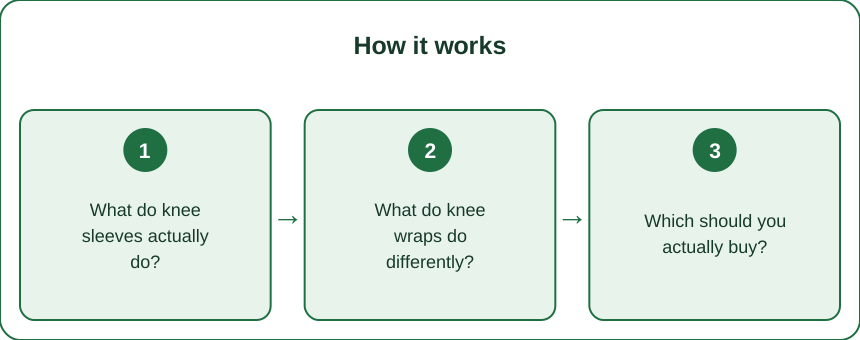
What do knee sleeves actually do?
Four things, none of which is meaningfully increasing your squat.
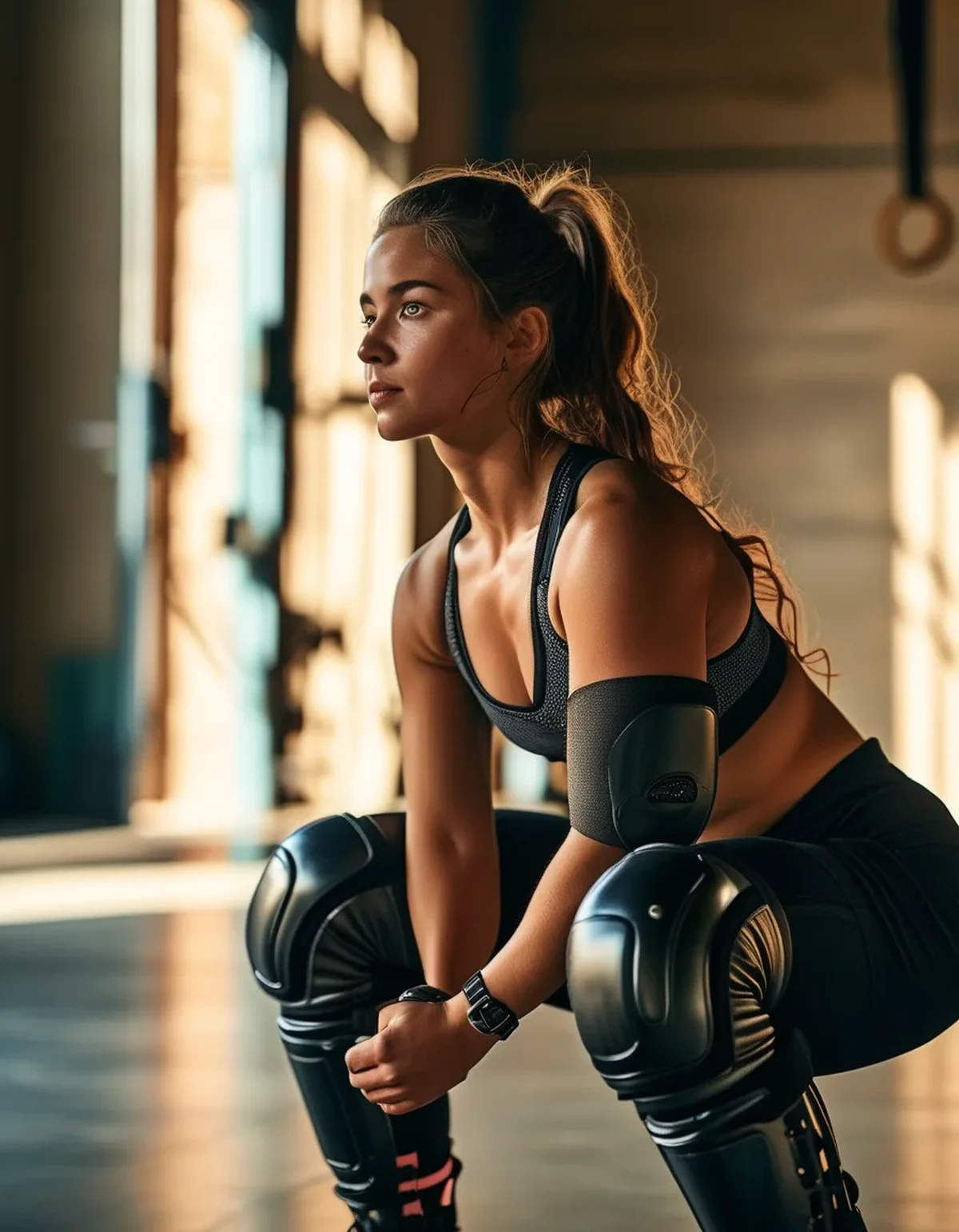
They keep the joint warm. This is the primary benefit and it is underrated. Neoprene retains heat, and a warm joint moves more comfortably, particularly in cold gyms and early sessions.
They provide light compression. Mild compression can reduce the sensation of swelling and feels stabilising to many people, particularly those with mild patellofemoral discomfort.
They give proprioceptive feedback. The pressure on the skin improves your sense of where the joint is, which many lifters report as feeling more controlled under the bar.
They add a small amount of rebound. A thick 7 millimetre sleeve provides a slight bounce out of the hole — genuinely a few kilograms at most, not a transformative effect.
They do not prevent injury. There is no good evidence that sleeves prevent knee injuries in lifting. They make lifting more comfortable, which is a valid reason on its own.
Thickness determines the character. Five millimetre sleeves are comfortable and suit general training and higher reps. Seven millimetre sleeves are stiffer, warmer and better for heavy work but less pleasant for long sessions.
What do knee wraps do differently?
They are a performance tool with a real mechanical effect and a real cost.
They store and return elastic energy. Wrapped tightly, the material is stretched as you descend and returns force as you rise. Out of the bottom of a squat this can be substantial.
The effect is measurable, not marginal. Experienced lifters commonly report meaningful increases on maximal squats with tightly applied wraps, which is why they are regulated in competition.
They change the movement pattern. Wraps encourage a more vertical, quad-dominant descent and can make it harder to hit depth or to sit back. This is why squatting wrapped and unwrapped feel like different exercises.
They shift stress rather than remove it. By assisting at the bottom, wraps alter loading on the patellofemoral joint and can increase shear forces. This is a trade, not a free benefit.
They must be removed between sets. A properly tight wrap is genuinely uncomfortable and restricts circulation. Leaving them on through a session is not the intended use.
They take skill to apply. A well-wrapped knee and a badly wrapped knee behave completely differently, and most people need someone to teach them.
Federation rules vary. Wraps are permitted in some divisions and banned in others, with length limits. Check before you build a peak around them.
Which should you actually buy?
For the overwhelming majority of lifters, the answer is sleeves.
Buy sleeves if you train for general strength or health. They make training more comfortable, especially in cold conditions, and there is no downside to wearing them.
Choose 5 millimetre for general training. Comfortable enough for a whole session, warm enough to matter, not so stiff that they interfere with higher-rep work.
Choose 7 millimetre if you squat heavy regularly. More support, more warmth, more rebound, less comfort. Many people own both.
Buy wraps only if you compete in a division that allows them and you are peaking. Outside that context they mostly add complexity and reduce training quality.
Do not train every session in wraps. Doing so means never training your knees to handle the bottom position unassisted, which is the opposite of what training should do.
Size sleeves snugly. They should be genuinely difficult to pull on. A sleeve you can slide on easily is doing very little.
Sleeves are not a substitute for addressing pain. Persistent knee pain during squats deserves assessment rather than a thicker sleeve. This is general information, not medical advice.
Seasonal note: sleeve sales spike in autumn for a reason. Cold gyms make joints feel stiffer and warm-ups take longer, and a sleeve genuinely helps with that specific problem.
Myth vs Fact: Knee Support
Myth: Sleeves will add 10 kilos to your squat. Fact: A few kilos at most, mostly from the rebound in thicker sleeves. If you want a real increase, that is what wraps do.
Myth: Wearing sleeves makes your knees weak over time. Fact: There is no good evidence for this with sleeves. The concern is more reasonable with heavy wraps used on every set, because they genuinely reduce the demand.
Myth: Sleeves prevent injury. Fact: They improve comfort and warmth. Injury prevention comes from load management and technique.
Myth: If your knees hurt, wear a sleeve. Fact: A sleeve can make training more comfortable, but it does not address the cause. Recurring pain needs assessment.
Myth: Tighter wraps are always better. Fact: Past a point, tighter wraps compromise depth, circulation and control. There is a correct tension and it is learned, not maximised.
FAQ: Knee Sleeve and Wrap Questions, Answered
Should I wear sleeves for every set?
Many people wear them for the whole session and that is fine. Some prefer to warm up without them and add them for working sets.
What size sleeve do I need?
Measure your leg where the brand specifies, usually mid-thigh or just below the knee, and follow their chart. When between sizes, most competitive lifters size down and most general trainees size up.
How do I stop them smelling?
Hand wash after every few sessions, air dry fully, never leave them balled up in a gym bag. Neoprene holds odour aggressively once it sets in.
Can I use wraps for deadlifts?
No useful purpose, and they restrict the movement. Wraps are a squat tool.
Are wraps bad for your knees?
Used occasionally and correctly, they are a legitimate competition tool. Used on every set of every session, they alter loading in ways worth avoiding.
Do I need either of these as a beginner?
No. A sleeve is a comfort purchase you can make any time. Wraps are for competition.
TL;DR:
- Sleeves: warmth, compression, proprioception. Worn all session. Minimal effect on load.
- Wraps: stored elastic energy for maximal squats. Removed between sets. Regulated in competition.
- Buy 5mm sleeves for general training, 7mm if you squat heavy.
- Do not train every set in wraps — it removes the demand you are trying to train.
- Neither prevents injury. Load management does.
If you are not competing in a wrapped division, buy sleeves and stop thinking about it.
Keep Reading
This article is for general informational and styling purposes only. Fit, sizing, and product availability may vary.